Friday, March 9, 2012

Happiness is a Warm Tripod

I am invariably stymied at the general lethargy of some miniature casters.  This latest pronouncement of mine comes after a particularly long search for a proper German War Tripod for Space 1889. 

The Atelier de la Charrett, who have in the past made a Really Good Steam Walker, seems to be "souffrance de la caffard", in that they are in no hurry to re-release their Parroom Station Steam Tripod. Most of the other older sources also appear to have dried up.

You would think, in the general stampede to board the Steampunk Bandwagon, that someone would be interested in getting it right?

After much internet searching, speculating and hand-wringing, I've finally purchased some vehicles from Ironclad Miniatures. Including their Steam Walker.

Even though the Ironclad model is a four-footed walker, it is easily modified to a tripod. I should have done this years ago. Lovely detail, excellent workmanship, and I had friendly service from John L. at Ironclad.

The kit comes with four legs, crew compartment, stack and gun, and a mounting platform. My initial hesitation was due to not knowing if I could easily remove the crew compartment from the gear box. I needn't have worried. Praise and glory be to Ironclad for casting the crew compartment separately from the gearbox/mounting platform. Platform and one leg have been placed in the bits box while a washer and cast-off sci-fi TARDIS column base serve to convert to a tripod with gearbox.

I've also reversed the crew compartment to look more like a turret, again to keep inline with the Chadwick design. This meant puttying over the stack aperture. This was a small pity because one can see the thought that went into the design, including a molded ring to secure the stack.  Nice!

A touch of styrene card as a gun-port cover, an external firebox for the experimental coal-oil engine, and viola!


                               Panzerkampfdreifus Storch!

Now to work on some "Trample" rules for Soldier's Companion. Mwahahaaaaa.

- finis -


Saturday, February 25, 2012

Les Marsouins

Finally finished my Old Glory Troupes de Marine (French Marine Infantry).

Marsouin means "porpoise", as the Marines went where the fleet went and followed the navy.

Not to be confused with Fusilier Marines, which are naval sailors trained as infantry to defend naval installations, the Troupes de Marine are the French equivalent to the British Royal Marine Light Infantry. They were at the forefront of hostilities in Tonkin and Madagascar, and they often went where the Legion could not go.


They are painted here in their experimental 1894 Mechanic's Blue denims, which they wore at Tiensen, China and the Relief of Peking. For Space 1889 purposes, I assume a gradual acceleration of the historical timeline, or as I ask my gamers "That?  That's what's bothering you?  They're wearing a kit five years too early...on MARS?"


- finis

Saturday, January 28, 2012

Status Counters for Soldier's Companion

One of the many benefits of Frank Chadwick's Soldiers Companion is it plays clean, in that one doesn't need to consult tables and charts whilst playing the game.  Rosters are also kept to a minimum, and a unit roster reads very much thusly:

1st Btn. South Wales Borders - V1
Breechloader Rifles 12/24

Troop identification, Quality (V for veteran), Fieldcraft (1) and weapon (Martini-Henry rifle)

There are no boxes for casualties as the figs are knocked down/lifted/given full honours as the firing is resolved. Moral state can be recorded as it fluctuates.

The need for some counters became apparent to me after many games playing Soldier's Companion through the years, and while I don't like a lot of board clutter, in some cases I am forced to admit that a discreet counter would have been welcome in avoiding a bad call.

There are three variable states that are linked to morale, but aren't actual morale factors under the rules:
Checked
Charging
Frenzied

Checked occurs when morale effects are resolved - a morale roll failed by 2 or less results in a unit becoming Checked.  They fire with a 1 pip penalty, and have some melee disadvantages. A checked unit may also not advance towards the enemy.

Charges are declared before movement, before initiative is determined.  Charges aren't resolved until after fire, so it's sometimes not difficult to forget in a big game if a unit is charging or being charged.

Frenzied is another morale state, which occurs when a unit witnesses a friendly unit winning a melee. Frenzied units count towards winning initiative, and frenzied units must charge the nearest enemy unit.

Litko Aero makes some nice counters (I picked up mine at the Wargames Vault during a sale) so it wasn't difficult finding appropriate counters.

Now to see if they'll help me win.

- finis -

Thursday, January 26, 2012

More Œnotrian Artillery

Here are a coupe of rogue guns for use in defending town walls.  Rogues performance is equivalent to that of the 68-pounder, albeit with a slower rate of fire.  This can be explained by the 68's use of the percussion cap for firing, while the rogue still uses the "prick and prime" method.


Rogues are not much seen in the field, being very heavy and difficult to maneuvre, but they are useful in knocking down the walls of smaller Martian states. Any siege train on Mars expecting to carry the day will feature a battery of rogues, and any municipality hoping to resist will mount a few on the walls, as a deterrent.


These are part of a three-gun set from Scotia Grendel - you will find them under the Medium Dwarven Artillery.  As resin-cast, there is a bit of "greeblische" around the base, simulating churned-up dirt from the field. This might bother the extra-fastidious when deploying them on a stone parapet.

 I wasn't entirely certain these would scale well with my RAFM Martian gunners, but they do.

- finis -

Friday, December 30, 2011

28mm Œnotrian Artillery

For a start, I think the "proper" pronunciation of Oenotrian is "E-not-tree-an", with a long "e" to start, and not OH-not-trian as I occasionally hear.  The reason being that "Oenotria" is a classical Greek alternative name for Egypt, when it was spelled "Oegypt", and it follows the vast majority of the Greco-Roman Martian place names.  H.P.Lovecraft liked to use the word "Oegypt" in his poetry. This form survives in the 19th century spelling "EncyclopOEdia".

The same would hold for the "Moeris" in Moeris Lacus being pronounced "Meerus", and not "Mo-ris" unless you actually *want* to name your Martian geographica after the First Stooge.

Over the Christmas break, I finished three Martian cannon from the Paroom Station line carried by Brigade Games.  I've been using English Civil War cannon for my Martian artillery, and I'm really pleased to have begun the upgrade to these - I love these figures, especially the ancient sea-monster leokampoi ornamentation. 


They are not cheap - about twice the price of an Old Glory set of ECW artillery, but the capture the feel of Oenotria, or Tekumel, very well.

- finis -

Wednesday, December 28, 2011

Soldier's Companion Refresher - the Northwest Frontier

We played another Soldier's Companion refresher game this past Tuesday.  I had originally intended to field my new Martian artillery from Paroom miniatures in another canal-trotting scenario, but rumours of a large turnout caused me to switch to a Northwest Frontier scenario, of which I have figures aplenty.

(As it happened, it was a dismal, rainy winter's night, and half the attendees funked out through sickness or apathy.  Sickly apathetic swine...)

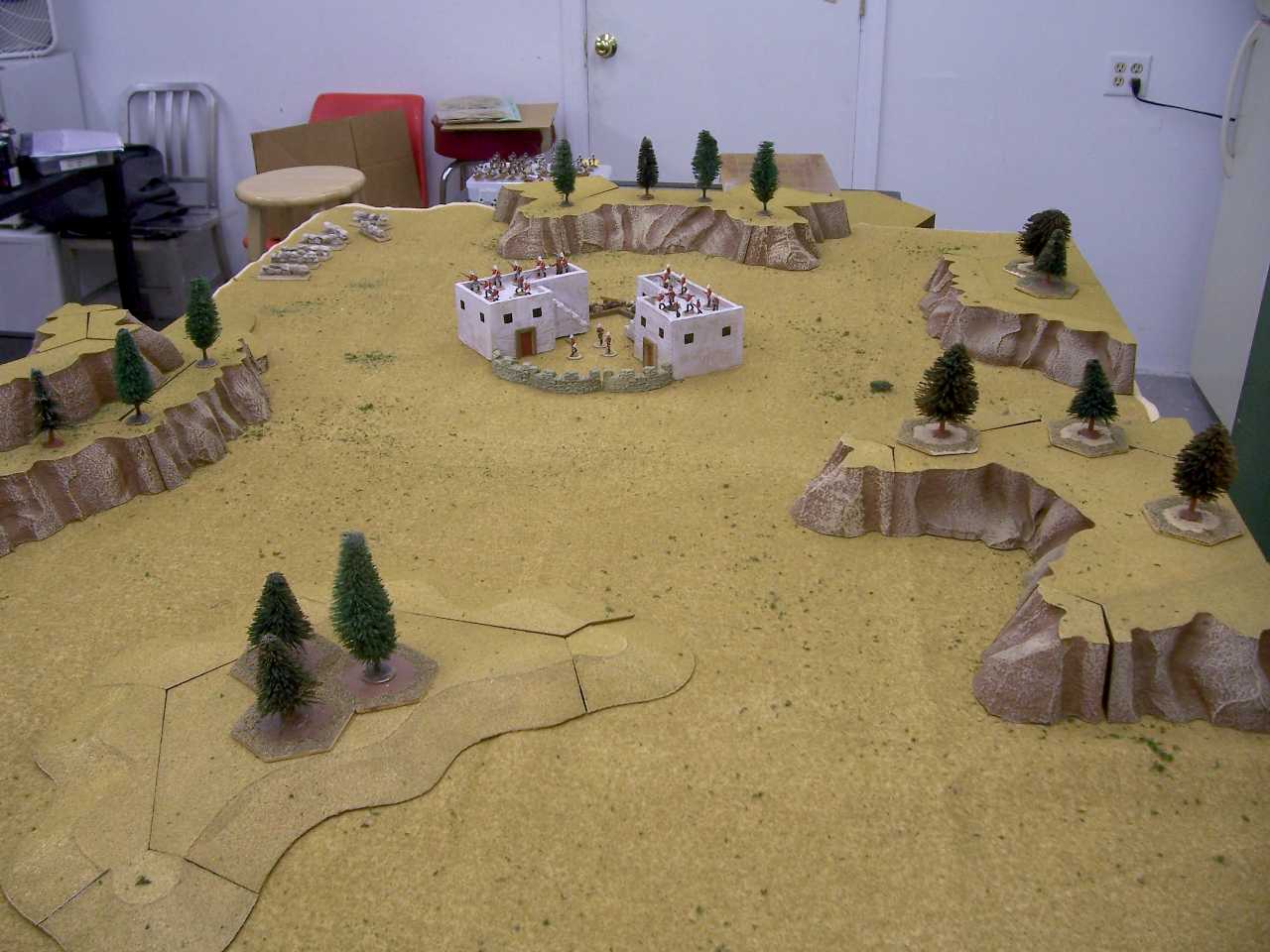
The scenario was set in 1863 and very loosely based on the events surrounding the Umbeyla Campaign. A British column has been damaged while traversing a supposedly friendly valley.  Two companies fall back to an abandoned mission station, dig in to await reinforcements, while the Pathans hold the high ground and take potshots at any man daft enough to put his head up.

It was something of a Colonial Gaming trope, the Besieged Outpost and all that, but I make no apologies as I had to come up with something overnight. Come to think of it, the Brits could have done with the addition of Jack Hawkins and Ulla Jacobsen figures, as the Meddling Civvies.

There were two 10-man companies of Highland Light Infantry, each in two detachments, defending the mission, and commanded by Mike (aka "Dr. Goldwyrm" due to an unfortunate resemblance to a stock James Bond villain). There were four 18-man Pathan war-bands - each armed half with melee weapons and half with rifled muskets, commanded by Tonri Khan. The Pathans hid their melee tribesmen in the brush at the base of each hill.
Setup


Umbeyla Mission

The first turn or two saw the two opponents sussing out how the shooting worked. Both sides were equipped with rifled muskets (being 1863, the British were still using the Enfield, proving you can teach an old dog a new trick, but can't make him drink, or something) but in SC the Pathans have a sharpshooter advantage, giving them a 50% increased range over the beleaguered Brits.  They could simply sit back and whittle the defenders down.

Not being much of a whittler, Tonri Khan decided to charge his sword-wielding Pathans in on the second turn, after causing one of the detachments to fail morale and become "checked".  Hmm...this should prove interesting, or at least amusing.

The Initial Pashtun Charge
Bursting out of cover, the screaming fanatics did catch the British defending player by surprise, but only slightly. The devilishly clever cove had hidden a five man detachment in one of the buildings, even I hadn't caught that.  As the Pathans were caught climbing the barricade, this surprise reserve dashed out of the building (using an optional "Reaction Half Move") and stood in the gap in open order.

Breaking In
Defending in open order against natives is never a good idea, unless they are attacking in open order, which these ones were. Due to the gap, the Pathans weren't able to bring their superior numbers against the defenders.  The attack was thrown back.

(We had a slight confusion as to where the Pathans withdrew to - they had been "pushed back" but couldn't reform within two inches of the Brits.  I decided to let them reform on the far side of the barricade, once they won initiative.)

On turn 3 the Relief Column arrived. Four companies of the 45th Sikhs, led by a company of Queen's Guides, accompanied by a mountain gun. Before they could move, the Pathan player stole the initiative by charging two more hidden units at the mission.


The Relief Column
Infantry defending a barricade get a +1 on their melee combat role. The HLI also had a +1 for quality superiority against the war-bands. Charging in open order gave the Pathans a morale disadvantage.  By the end of the turn, the attack had failed, and one of the half war-bands failed morale and broke. Meanwhile, the HLI who were defending the gap between buildings formed up and volley fired, sending the war-band that was inside the barricades back outside the barricades.

It's alright, lads! They're ours!

Tonri-Khan decided to pack it in, and I agreed with him. Colonel Goldwyrm was sending columns up into the hills to chivvy off any remaining firearm-wielding Pathans. and the elite Guides were going to tear up any Pathans that got too close.  We gave the day to the British.

Post-Game Thoughts

Rather than surround the British, the Pathans should have set up with two firearm units able to hit a single rooftop.  Instead, they deployed in a broad ring, which spread their sniping over the entire mission, and also left them vulnerable to the Relief Columns counter-attack. Having done that, the Pathan player could have relied upon firepower to cause the British to blink.

Pathans could have done with one more war-band to slow down the Relief Column, or at least make them work a bit for it.

The British player was dismayed by the lack of firepower the Crown's forces had at their disposal in 1863. The Enfield musket gave the HLI one shot per two men, and because they were scattered about the mission, could only put one or two dice (usually one) on the charging war-bands. It would have been better to form up and charge the hills with the bayonet, except that I had lumbered him with extra wounded at the start of the game.  Such is the life in the Queen's service.

-finis-


Saturday, December 24, 2011

Askari Miniature’s Senegalese Tirailleurs


I decided to restart my 19th Century gaming with a slight shift - and have begun painting a French force for use in West Africa, Chad and Mars.  Being tied to the "middle" 25mm scale, as that is what the majority of my hundreds of minis are, I sought out Askari Miniatures for the backbone of French Imperialism on the Dark Continent - the Tirailleurs Senelgais.
Tirailleurs Advancing (1 inch grid)

I must admit, I have some mixed feelings about these figures. The scale is good “larger 25mm”, like the old Frontier Miniatures or the more modern RAFM lines. Animation is a bit stiff, especially on the French officers. The rank and file soldiers are similar par to the old Frontier Miniatures line, and are sculpted Advancing and Firing.  The metal is a tad brittle, and in two shipments, I've received three riflemen with broken-off bayonets.

Firing

The detail is fair – I’m probably spoiled by Bob Murch’s sculpts of the Space 1889 figures.

Colonial Artillery Command Pack
These figures match up well with RAFM Colonial and Space 1889 figures, and that counts quite a bit. 


Size Comparison with RAFM British (darker)


As far as the line goes, there are Not Enough Poses.  NCO positions are being filled by the various command askari, but they are not wearing the complete Tirailleur kit (barefoot). The line would benefit from the addition of a figure lunging or charging with the bayonet.

Painted in Ministry du Marine uniform

Animation: 3
Variety: 3
Detail: 3
Proportions: 3

Final grade: 3 (out of 5) 

- finis